01 / THE POTENTIAL
More stable blood sugar
For selected patients, transplanted islets can reduce dangerous low blood sugar episodes and the need for injected insulin. Some people become insulin independent.
Type 1 diabetes · A campaign for change
Support the ISLET Act. Help bring islet cells from deceased donors into the organ transplant system—and expand access to a treatment that can change lives.
Islet cells are small clusters of cells in the pancreas, an organ behind the stomach. Some make insulin, the hormone that helps sugar move from your blood into your cells for energy.
In type 1 diabetes, the immune system mistakenly destroys the cells that make insulin. People must replace that insulin to manage their blood sugar.
An islet transplant transfers insulin-producing cells from a deceased donor into another person. The goal is to help the body make insulin again.
For selected patients, transplanted islets can reduce dangerous low blood sugar episodes and the need for injected insulin. Some people become insulin independent.
Our goal is a future where everyone with type 1 diabetes can access safe, effective cell replacement treatment. The donor-islet approach using tegoprubart is currently being studied in clinical trials, with eligibility limited by study requirements.
Early tegoprubart trial results show encouraging insulin independence and safety findings. Larger studies and longer follow-up are needed to understand the benefits and risks.
Learn more from the National Institute of Diabetes and Digestive and Kidney Diseases.
The whole pancreas is regulated as an organ for transplantation. But donor islet cells taken from that pancreas face a separate FDA drug approval pathway.
Transplant advocates argue that this difference creates barriers for hospitals seeking to offer islet transplants. Our campaign supports regulating donor islet cells through the organ transplant system, with strong patient protections.
Donor islet treatments must meet FDA product licensing requirements. Advocates say this approach makes routine access harder for transplant programs.
Recognize islet cells from deceased donors as organs for transplantation, with standards for donor screening, cell preparation, allocation, and follow-up care.
An international difference: According to the Islets for US Collaborative, the United States is the only developed nation that regulates donor islets as drugs rather than as organs for transplantation. This is the Collaborative’s comparison of donor islet policy, not a claim about every type of cell therapy. Read the experts’ position.
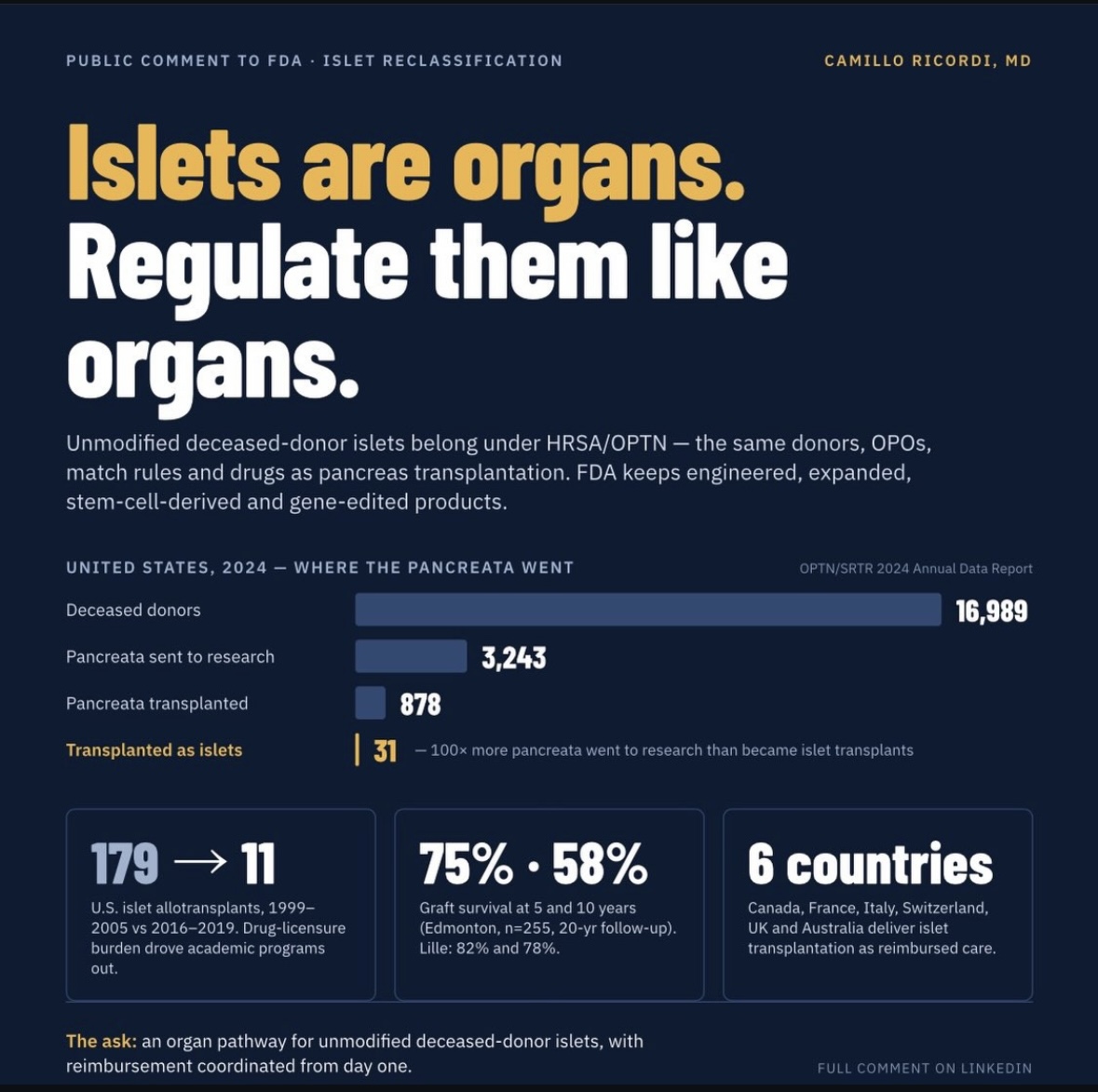
Advocacy graphic provided for this campaign. The graphic cites the OPTN/SRTR 2024 Annual Data Report for its pancreas-use chart.
The graphic reports 16,989 deceased donors, 3,243 pancreata sent to research, 878 pancreata transplanted, and 31 transplanted as islets in the United States in 2024. These categories describe different measures and should not be added together.
It also compares 179 U.S. islet transplants in 1999–2005 with 11 in 2016–2019; reports Edmonton graft survival of 75% at five years and 58% at ten years, and Lille figures of 82% and 78%; and identifies Canada, France, Italy, Switzerland, the UK, and Australia as countries offering reimbursed islet transplantation. Graft survival means the transplanted cells continue functioning; it does not necessarily mean insulin independence.
The graphic advocates an organ pathway for unmodified donor islets, while retaining FDA oversight of engineered, expanded, stem-cell-derived, and gene-edited products.
The Increase Support for Life-saving Endocrine Transplantation Act would recognize islet cells from deceased donors as organs under federal transplant law.
The Senate bill was introduced by Senator Mike Lee, with Senator Ted Budd as an original cosponsor. Its goal is to move these donor cells into the framework used for organ transplantation.
This is proposed legislation. The separate public-comment process below gathers input for federal agencies; it does not enact the bill or change the rules by itself.
Read S. 3105 on Congress.gov · Read H.R. 8018Tell the Department of Health and Human Services why access to donor islet transplantation matters. Submit your comment by November 9, 2026, at 11:59 p.m. Eastern Time.
Use the template as a starting point. Explain your connection to type 1 diabetes and the access barriers you want addressed.
Edit the text, replace the bracketed prompts, and copy it when you are ready.
Open the official comment form, paste your text, and follow its submission instructions. Copying here does not submit a comment.
Comments and attachments may be public. Share only personal details you want included in the public record.
Read the official request and deadlinePublic comments reach federal agencies. Contacting your senators and representative is a separate way to advocate for S. 3105 and H.R. 8018.
Find your senators · Find your representativeBehind the policy are people living with type 1 diabetes. Explore personal accounts of donor islet transplantation and clinical research.
A personal account featured by Eledon, a company developing treatments used in transplant research.
Read Marlaina’s storyT1D Exchange shares a participant’s experience with an islet cell transplant study.
Read the T1D Exchange storyIndividual experiences do not predict everyone’s results. Clinical research is different from routine treatment.
It can restore insulin production and improve blood sugar control in selected patients. Some recipients stop needing injected insulin for a time. It is not a guaranteed or permanent cure, and recipients generally need ongoing medicine to prevent rejection.
Hypoglycemia means low blood sugar. A severe episode is one in which a person needs help from someone else to recover. It can cause confusion, seizures, or loss of consciousness.
HHS is the Department of Health and Human Services. FDA is the Food and Drug Administration, which oversees medicines and many treatments. HRSA is the Health Resources and Services Administration, which oversees the federal organ transplant system. OPTN is the Organ Procurement and Transplantation Network, which develops transplant policies and manages organ matching.
Reclassification could open a path to treatment for more eligible patients—and, for some, the possibility of life without insulin injections or a pump. Advocates argue that treating islet cells from deceased donors as organs would remove drug licensing barriers that make it difficult for hospitals to offer this care. With appropriate transplant standards, more qualified centers could be able to provide treatment.
A broader network of treatment centers could mean less travel and more opportunities for eligible patients to be evaluated and receive a transplant. Advocates also hope the change would help address affordability and insurance coverage, although those improvements would require additional decisions and are not automatic.
The connection to insulin independence is straightforward: transplanted islet cells can make insulin inside the recipient’s body. If they produce enough, a patient may be able to reduce or stop using injected insulin. Expanding access could give more eligible people the chance to benefit from that possibility.
That is why this change matters: it could bring a life-changing treatment within reach of more people who need it. It would not guarantee a transplant or permanent freedom from insulin. Donor supply, insurance coverage, medical eligibility, and how well the cells work would still matter, and recipients need medicine to prevent rejection.
Learn about transplant outcomes and insulin independence from NIDDK, and the access questions federal agencies are considering.
No. This campaign focuses on islet cells taken from the pancreas of deceased donors. Cells developed from stem cells involve different production methods and regulatory questions.
No. Federal agencies are collecting information before deciding what to do. The current request does not itself change treatment approvals or federal requirements.